








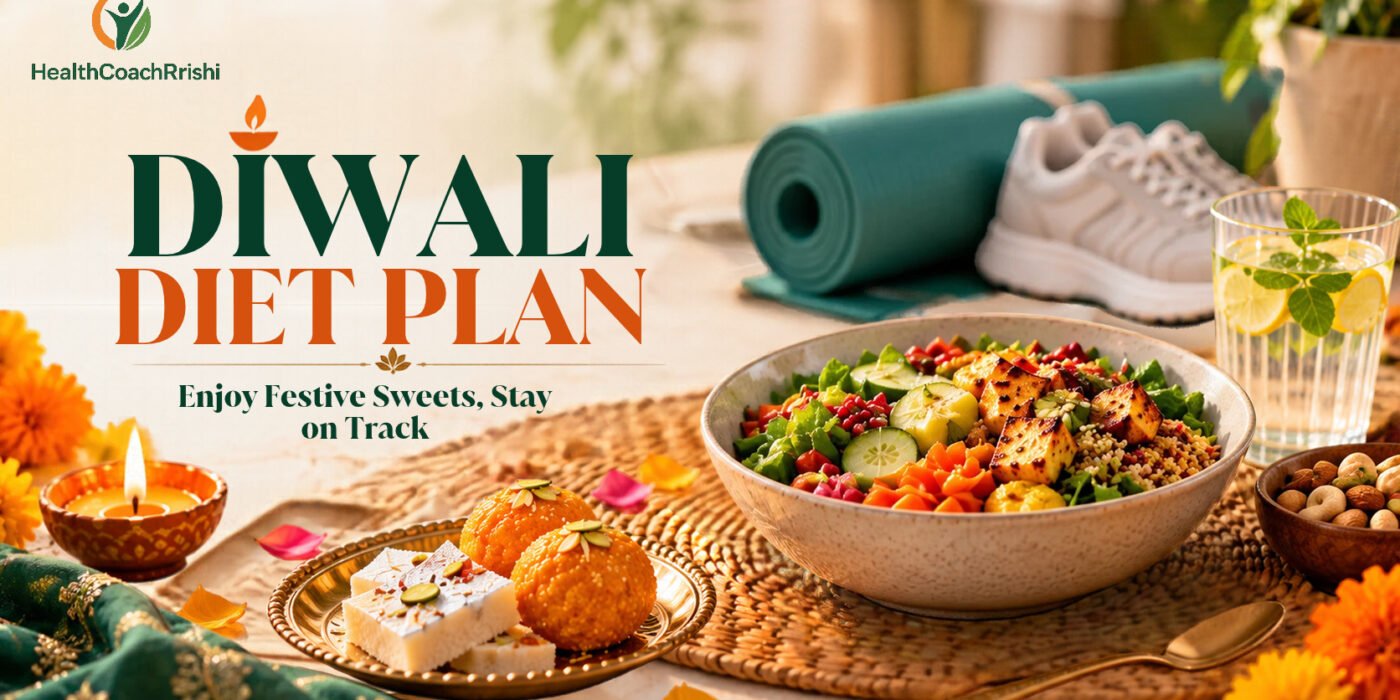
The mithai boxes usually arrive before Diwali does. A client drops off kaju katli, the office orders a tray of laddoos, and by the time Lakshmi Puja comes around on Sunday, 8 November 2026, you have eaten your way through a week of “just one piece.”
If you have spent months building better habits, that can feel like a threat. It doesn’t have to be. A good Diwali diet is not about saying no to sweets. It is about deciding in advance how you want to enjoy them, so one festive week stays one festive week instead of becoming the start of a slide.
This guide covers what the research actually says about festive weight gain, which Diwali sweets are lighter or heavier choices, a sample Indian diet plan for Diwali day, healthy Diwali snacks, and what to do afterwards (spoiler: you don’t need a detox).
What happens to your body during a festive week?
Most of us overestimate the damage of one celebration and underestimate the damage of a habit.
Most research on festive weight gain comes from Western holiday seasons rather than Diwali specifically, but the pattern is useful. In a well known study published in the New England Journal of Medicine, researchers weighed 195 adults across the autumn and winter holidays. The average gain over the holiday period was small, about 0.37 kg, far less than people assumed. Participants actually believed they had gained around three times as much as they had.
The catch is that this small gain was not lost in the months that followed. Researchers suggested that these modest, unreversed festive gains may add up to the slow weight creep many adults notice over the years. The same study found that people who reported being more active gained less, while those who reported feeling hungrier gained more.
Two practical lessons follow. First, a few sweets will not undo your progress, so there is no need for guilt or extreme restriction. Second, what matters most is getting back to your normal routine quickly, rather than letting the festive pattern stretch into weeks.
How can I enjoy Diwali sweets without gaining weight?
The short answer: plan your sweets rather than graze on them, eat them after a meal that contains protein and fibre, keep portions small, stay active, protect your sleep, and return to normal eating the day after. Here is how each of those works.
1. Decide your “worth it” sweets in advance
Most festive overeating is not the gulab jamun you love. It is the random barfi from a box you didn’t even enjoy, eaten because it was there. Before the week starts, pick the two or three sweets you genuinely look forward to every year. Enjoy those fully and let the rest go. This one decision cuts out a surprising amount of mindless eating.
2. Eat sweets after a meal, not on an empty stomach
The order in which you eat appears to matter for blood sugar. In a small study published in Diabetes Care, adults with type 2 diabetes ate the same meal on two days. When they ate vegetables and protein first and left the carbohydrates for last, their blood sugar was roughly 29%, 37% and 17% lower at 30, 60 and 120 minutes than when they started with the carbohydrates. A follow up study in people with prediabetes found that glucose peaks were more than 40% lower with the vegetables and protein first order.
These were small studies in people with impaired blood sugar control, so the effect may be smaller in healthy adults. Still, the habit costs nothing. In practice, it means having your mithai as a dessert after dal, paneer, sabzi or salad, rather than as a standalone snack at 4 pm.
3. Don’t skip meals to “save” calories
Skipping lunch so you can eat freely at the evening party usually backfires. You arrive hungry, and hunger makes portion decisions much harder. Recall that in the holiday weight study, people who reported more hunger tended to gain more. A balanced breakfast and lunch, plus a small protein rich snack before you head out, keep you in control of the sweet table instead of the other way round.
4. Take a short walk after big meals
A 2022 meta analysis in Sports Medicine pooled seven studies and found that breaking up sitting with short bouts of light walking lowered post meal blood sugar by around 17% on average compared with staying seated. Even breaks of two to five minutes helped, and walking worked better than simply standing.
After a festive lunch or the evening puja, a 10 to 15 minute walk around the colony is easy to fit in. If air quality is poor around Diwali in your city, walk indoors, climb a few flights of stairs, or do some light household activity instead.
5. Protect your sleep
Late nights of card parties, crackers and catching up are part of Diwali, but sleep has a direct line to your appetite. In a small controlled study in the Annals of Internal Medicine, healthy young men who slept only four hours for two nights showed lower levels of leptin (a hormone that signals fullness), higher levels of ghrelin (a hormone that signals hunger), and a stronger appetite, especially for calorie dense, carbohydrate rich foods.
You won’t always get a full night during the festive week, but try to keep at least the nights before and after the main day reasonably normal. If you notice yourself reaching for sweets the morning after a late night, it may be the sleep talking rather than a lack of willpower.
6. Watch the drinks
Sweetened drinks, packaged juices, sugary chai and alcohol at Diwali parties add sugar and calories without filling you up. Alcohol can also make food decisions looser. Water, plain buttermilk, coconut water or unsweetened lemon water are easy swaps.
Which Diwali sweets are healthier, and how much can I eat without affecting my weight loss goals?
No mithai is a health food, and that’s fine. Sweets are meant to be enjoyed. But some are lighter choices than others, mostly depending on how they are cooked and how much sugar and fat they carry.
As a general rule, sweets that are deep fried and then soaked in sugar syrup are the heaviest. Sweets made mainly from milk, chhena (fresh cottage cheese), nuts, seeds or dates, and cooked with less ghee, tend to be lighter. Dense sweets like kaju katli and barfi look small, but they pack a lot into each piece, so the size can be deceptive.
| Category | Examples | Why |
| Lighter choices | Sandesh, homemade chhena sweets with less sugar, date and nut rolls, til (sesame) ladoo in small portions, roasted makhana kheer with less sugar | Less frying, often more protein or fibre, sugar easier to control when made at home |
| Moderate choices | Kaju katli, plain barfi, peda, besan ladoo, rasgulla (squeeze out the syrup) | Not fried, but dense in sugar, ghee or nuts, so portion size matters |
| Heavier choices | Gulab jamun, jalebi, imarti, balushahi, ghee rich halwa | Deep fried and/or soaked in syrup, so high in both sugar and fat |
A few nuances are worth knowing:
Jaggery and dates are still sugar. Sweets made with gur or dates may bring a little fibre or a few minerals, and many people prefer their taste, but your body still treats them as a source of sugar and calories. Treat them as a better tasting option, not a free pass.
“Sugar free” is not the same as “calorie free.” Sugar free mithai can still be rich in ghee, khoya and nuts, so the calories can remain high. Some sugar substitutes, especially sugar alcohols, can also cause bloating or loose stools if you eat a lot. Read labels and keep portions similar to regular sweets.
Homemade usually beats store bought. When you make sweets at home, you control the sugar, the type and amount of fat, and the piece size. Cutting barfi into smaller squares is one of the simplest Diwali health tips there is.
How much can I eat without affecting my weight loss goals?
There is no single number that suits everyone. It depends on your body size, activity, goals, health conditions and what else you eat that day. But public health guidance gives a useful frame.
The World Health Organization recommends keeping free sugars (sugars added to food plus those in honey, syrups and juices) below 10% of your daily energy intake, and ideally below 5%. India’s Dietary Guidelines from ICMR-NIN, released in 2024, recommend keeping added sugar to under 5% of daily energy. For someone eating around 2,000 calories a day, 5% works out to roughly 25 grams of sugar, about five teaspoons.
Many traditional sweets can use up a large share of that in a single piece. So a reasonable approach for most healthy adults trying to lose weight is:
- On the main festival days, enjoy one or two small pieces of the sweets you love most, ideally after a meal.
- On the other days of the week, keep sweets occasional rather than daily.
- Balance a sweet heavy day with simpler, protein and vegetable rich meals, not with skipped meals.
If you are actively losing weight, think of the festive week as a maintenance week. Aim to hold steady rather than push for a loss. That mindset removes the pressure, and holding steady through Diwali is a genuine win.
What is the best Indian diet plan for Diwali to enjoy sweets while staying healthy?
Here is a flexible template for the main day of Diwali. Swap in foods your family already cooks. The structure matters more than the specific dishes.
| Time | What to eat | Why it helps |
| Morning | A glass of water, then a protein rich breakfast: moong dal or besan chilla with curd, vegetable poha with peanuts and sprouts, or eggs with vegetables | Starts the day with protein and fibre, which help keep you full |
| Mid morning | A piece of fruit and a small handful of unsalted nuts or roasted chana | Prevents a big hunger dip before lunch |
| Lunch | Dal, rajma or chole, a vegetable sabzi, salad, one or two rotis or a moderate portion of rice, and curd or buttermilk | A balanced plate that keeps you steady through the afternoon of preparations |
| Evening, before puja or visits | Roasted makhana or chana, paneer tikka, or a bowl of sprouts chaat, with buttermilk or water | You arrive at the celebration satisfied, not starving |
| Puja and celebration | Your one or two “worth it” sweets, enjoyed slowly | You get the full festive experience, by choice rather than by default |
| Dinner | If dinner is festive and heavy: start with salad, vegetables and protein, keep the fried items and refined carbs to a smaller portion. If it is lighter: dal or paneer with sabzi and a roti | Food order and portions do the work without restriction |
| After dinner | A 10 to 15 minute walk, then aim for a reasonable bedtime | Supports blood sugar after the meal and appetite the next day |
Healthy Diwali snacks to keep around
Much of the festive damage comes from savoury snacks: namkeen, chakli, mathri and fried mixtures that are easy to eat by the handful. Having a few lighter options on the table makes it easier for you and your guests.
- Roasted makhana with a little ghee, salt and spices
- Roasted chana or peanuts instead of fried namkeen
- Steamed dhokla or idli with chutney
- Paneer or tofu tikka
- Sprouts or fruit chaat with lemon and chaat masala
- Baked or air fried versions of mathri and chakli
- Unsalted mixed nuts, served in small bowls rather than large platters
The serving trick matters as much as the snack. Small bowls and plates make it easier to notice how much you are eating than eating straight from a gift box.
Post Diwali detox diet: do you need one?
After a week of celebrations, “detox” teas, juice cleanses and three day resets start appearing everywhere. The evidence for them is weak. A critical review published in the Journal of Human Nutrition and Dietetics found very little clinical evidence that commercial detox diets help remove toxins or support weight management, and the authors could not find any randomised controlled trials testing these diets in humans. Any quick drop on the scale during a cleanse is likely to come mostly from eating far less, plus water loss, rather than any special detoxifying effect.
Your liver and kidneys already handle detoxification every day. What actually helps after Diwali is simpler:
- Return to your usual meal times the very next day.
- Build meals around vegetables, dal, legumes, curd, eggs, fish or paneer, with whole grains.
- Drink enough water and go easy on salty, fried leftovers.
- Get back to your normal movement routine, starting with daily walks.
- Prioritise two or three nights of good sleep.
- Give leftover sweets away or freeze them in small portions rather than finishing them in a week.
Think of it as a reset to normal, not a punishment for celebrating.
Common Diwali diet myths
Myth: “I’ve already eaten badly today, so the day is ruined.” One heavy meal doesn’t cancel your progress. The next meal is always a fresh decision.
Myth: “Skipping meals before the party will balance things out.” It usually leads to overeating later. Steady meals work better.
Myth: “Healthy sweets mean I can eat as many as I like.” Jaggery, dates and sugar free sweets are still energy dense. Portions still count.
Myth: “A detox will undo the festive week.” There is little evidence that detox diets do anything your body doesn’t already do. Regular eating does more.
Limitations and when to get personalised guidance
The strategies above are general, evidence informed habits for healthy adults. They are not a substitute for medical advice. People respond differently to the same foods depending on factors like body composition, activity levels, sleep, stress, medication and genetics, so what works well for one person may need adjusting for another.
If you live with diabetes, prediabetes, PCOS, thyroid conditions, heart disease or kidney disease, take medication that affects blood sugar, or are pregnant, speak with your doctor about how to handle festive foods safely. The research on food order and post meal walking is promising but comes mostly from small, short term studies, so treat these as helpful habits rather than treatments.
If you find festive weeks consistently derail your progress, that is often a sign that your everyday plan needs to be more flexible, not that you need more willpower. A personalised approach that looks at your routine, your biomarkers and your real calendar can help you build habits that survive Diwali, weddings and work travel alike.
The bottom line
A healthy Diwali diet is not about avoiding sweets. It is about choosing the ones you love, eating them after a balanced meal, staying active, sleeping reasonably well, and returning to normal the day after. Festive weeks themselves cause less weight gain than most people fear. What matters is not letting one week become the new routine.
Want a plan that fits your festive calendar?
If you’d like help building habits that hold up through Diwali, weddings and busy work seasons, start with a Personalized Health Discovery session. It looks at your lifestyle, nutrition, sleep and stress, and gives you a clear next step. Or book a zero-fee consultation to talk through your goals.
Frequently asked questions
1. Is it okay to eat sweets every day during Diwali?
For most healthy adults, a small piece of a favourite sweet on the main festival days is unlikely to affect long term progress. Eating sweets every day of the week adds up, so keep them for the days that matter most to you and enjoy them after a meal.
2. Are jaggery sweets healthier than sugar sweets?
Jaggery may offer small amounts of minerals and a different flavour, but it is still a form of sugar and is similar in calories. Treat jaggery sweets as a tastier option, not a reason to eat more.
3. Do I need a post Diwali detox diet?
No. There is little scientific evidence that detox diets remove toxins or help with lasting weight loss. Returning to regular, balanced meals, staying hydrated, moving daily and sleeping well is the most effective reset.
4. Which Diwali sweets are lowest in calories?
Generally, chhena based sweets like sandesh, and homemade sweets with less sugar and ghee, are lighter than fried, syrup soaked sweets like gulab jamun, jalebi and balushahi. Exact calories vary widely by recipe and piece size.
5. Can people with diabetes eat Diwali sweets?
This depends on individual blood sugar control and medication, so it is best discussed with your doctor. Many people with diabetes are advised to keep portions very small, eat sweets after a balanced meal rather than alone, and monitor their glucose more closely during festivals.
6. How do I get back on track after Diwali?
Start with your very next meal. Return to your usual meal times, focus on protein, vegetables and whole grains, resume daily walks, and give away or freeze leftover sweets. Most people feel back to normal within a few days.
Leave a Reply