









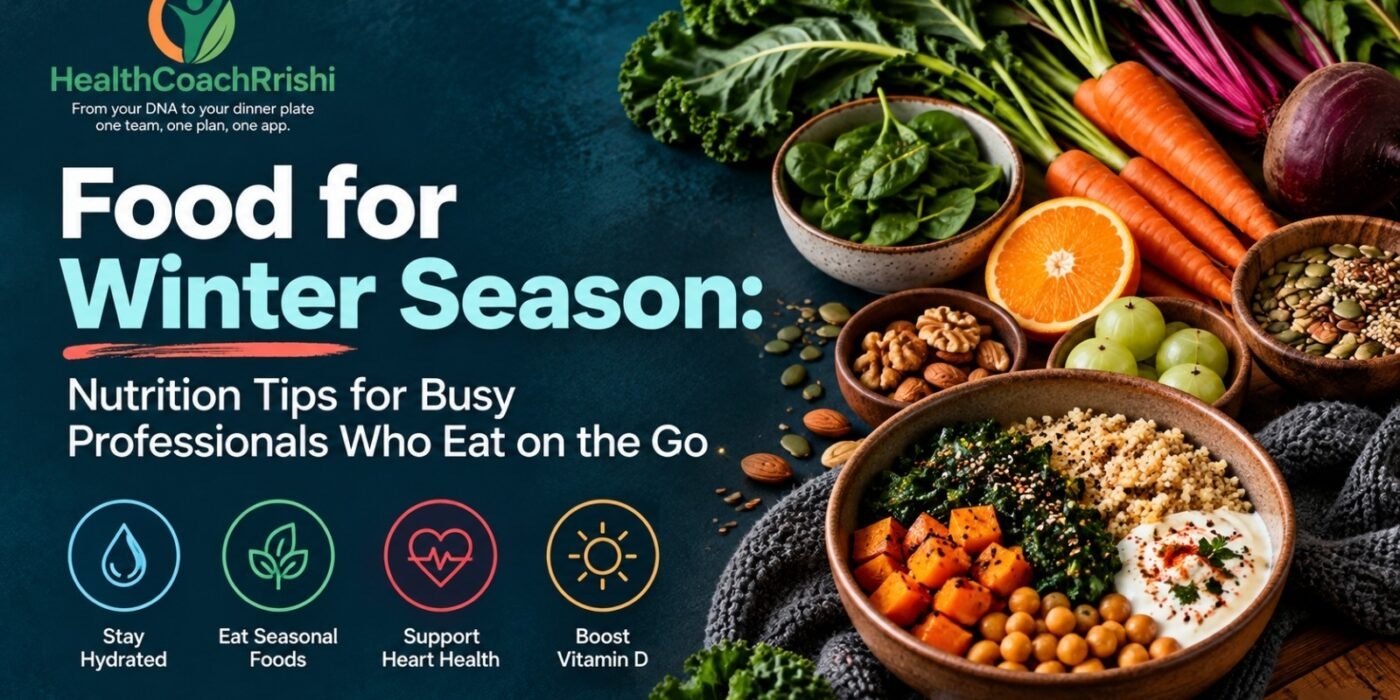
Most winter food advice stops at a list: eat bajra, add ghee, have some gur. That misses what actually changes in winter. Your thirst signal weakens. Your blood pressure tends to rise. Blood sugar control often slips. Daylight drops just as your step count does, and in north India the air turns hazardous for weeks.
For a professional who eats between meetings, these shifts are easy to miss because none of them announce themselves. This guide explains what happens in your body when the season turns, which food for winter season genuinely helps, and how to build a healthy winter diet when most meals happen at a desk, in a cab or at an airport.
What Is the Best Food for Winter Season?
The best food for winter season is fresh and local: leafy greens such as sarson, methi, palak and bathua; root vegetables like carrot, beetroot, radish and sweet potato; vitamin C–rich amla, guava and oranges; minimally processed millets such as bajra and ragi; and pulses, nuts, seeds and fermented foods like curd and kanji.
That overlaps heavily with a healthy diet in any season. The ICMR-NIN Dietary Guidelines for Indians (2024) recommend that vegetables, fruits, greens and tubers make up roughly half of your daily intake, with at least half your cereals as whole grains. What winter changes is the context around eating, and that is where the useful detail lies.
What Actually Changes in Your Body in Winter
1. Your thirst signal weakens before your hydration does
In a controlled study published in Medicine & Science in Sports & Exercise, cold exposure reduced thirst by up to 40%. The mechanism is specific. In the cold, blood vessels in the skin narrow to conserve heat, pushing more blood towards the chest. Volume sensors there read this as “plenty of fluid”, so the body releases less vasopressin, the hormone that drives both thirst and water conservation. In the study, this happened even when participants’ blood was already more concentrated than normal, a clear sign of mild dehydration.
Add heated offices and dry air, and thirst becomes an unreliable guide for the whole season.
2. Blood pressure climbs as temperatures fall
Cold makes blood vessels constrict, and blood pressure follows. In the China Kadoorie Biobank, a study of 23,000 adults with existing cardiovascular disease, average systolic pressure was 145 mmHg in winter against 136 mmHg in summer. Above 5°C, every 10°C drop in outdoor temperature was linked to roughly 6 mmHg higher systolic pressure, and the effect was larger in homes without central heating, which describes most Indian homes.
Diet is one lever you control here, and salt is the obvious one. ICMR-NIN advises no more than 5 g of salt a day; ICMR’s National Institute of Epidemiology estimates the average Indian eats about 11 g. Winter favourites such as pickles, papad, namkeen and salted snacks push that higher, precisely when blood pressure is already rising.
3. Blood sugar control tends to slip
In people with diabetes, HbA1c (the three-month average blood sugar marker) tends to run higher in cooler months in both hemispheres, with only minimal variation in a country with stable temperatures. In a Scottish dataset of 171,442 patients, about 45% showed higher HbA1c in winter. Researchers attribute this to festive eating, lower activity and temperature effects.
India does not fit neatly. A study of 8,138 patients at an Indian tertiary hospital found the highest levels in the monsoon, not winter, though people with well-controlled sugar did run higher in winter. The practical point holds either way: seasonal changes in eating and movement show up in blood sugar.
4. Vitamin D drops from an already low baseline
A systematic review of 40 studies found vitamin D deficiency widespread among apparently healthy Indians, regardless of sun exposure. An analysis of 11,428 tests in north-western India found a median of 17.2 ng/mL, below the commonly used 20 ng/mL cut-off, with seasonal effects visible and the lowest levels in young adults.
Winter sun may not rescue this in the north. In a multi-centre UVB study, vitamin D–forming UVB in Delhi peaked between 11 am and 1 pm and was strongest in March–June and September–October; Delhi schoolchildren who spent 30 minutes in late-morning winter sun daily for four weeks showed no rise in vitamin D levels. Food helps only partly: very few foods naturally contain vitamin D.
One nuance most articles skip: correcting a deficiency is not the same as using vitamin D as a shield. The VITAL trial gave about 26,000 US adults 2,000 IU daily or placebo for over five years; it did not reduce total cancer or major cardiovascular events. Test, treat a confirmed deficiency with your doctor, and skip the megadoses.
5. You move less, and the season’s extra weight tends to stay
In a UK study, adults’ step counts fell from summer to winter, by about 1,700 steps a day in normal-weight participants. In the best-known holiday study, 195 adults gained an average of only 0.37 kg through the November–January season, but that weight was not lost over the following year, and those who were less active or hungrier gained most. Both studies are from the UK and US; we lack equivalent Indian data for the Diwali-to-Sankranti stretch.
6. In north India, it is also pollution season
You may have seen claims that certain foods “detox” smog. A 2018 review in Respiratory Research found some signals that antioxidant vitamins and omega-3 fats may blunt pollution damage, but no direct evidence that any diet pattern protects against air pollution. Eat well for your overall health, but rely on masks, purifiers and limiting outdoor exertion on bad-air days, not on food.
7. Immunity: what food can and cannot do
A Cochrane review of placebo-controlled trials found that regular vitamin C (200 mg a day or more) did not reduce how often the general population caught colds, though it shortened them by about 8% in adults. Starting only after symptoms showed no consistent benefit. Daily vitamin C–rich food through winter is the sensible reading.
Healthy Food for Winter Season: What to Put on Your Plate
Think in food groups rather than “superfoods”. The table maps winter’s best produce to what it does and how to eat it away from home.
Food group | Winter picks | What it offers | On-the-go format |
Green leafy vegetables | Sarson, methi, palak, bathua | Fibre, folate, iron, calcium, potassium | Methi thepla or palak paratha in the tiffin; saag at home |
Roots and tubers | Carrot, beetroot, radish, sweet potato | Fibre, beta-carotene (carrot, sweet potato) | Roasted shakarkandi chaat; carrot and radish sticks |
Vitamin C fruits | Amla, guava, oranges, kinnow | Vitamin C; boosts iron absorption from plant foods | A whole guava or orange in your bag; amla slices |
Millets and whole grains | Bajra, ragi, jowar, makki, whole wheat | Fibre, minerals, a gentler blood sugar response than refined grains | Bajra or ragi roti in the tiffin; ragi dosa |
Pulses and protein | Dal, chana, rajma, sprouts, eggs, paneer, fish, chicken | Protein for fullness and muscle; B12 from animal foods | Roasted chana, boiled eggs, sprouts chaat |
Fermented foods | Curd, chaas, kanji, idli and dosa | Live microbes; a possible route to a more diverse gut microbiome | A bowl of curd at lunch; idli for breakfast |
Nuts and seeds | Til, peanuts, flaxseed, walnuts, almonds | Live microbes; a possible route to a more diverse gut microbiome | A small box of mixed nuts |
Warm fluids | Vegetable soups, rasam, herbal tea | Hydration that feels right in the cold | A flask of soup or warm water at your desk |
Why millets earn their place
Millets are more than nostalgia. A systematic review and meta-analysis of 65 human studies found millets had a mean glycaemic index (GI) of 52.7, about 36% lower than milled rice (71.7) and refined wheat (74.2). Bajra and ragi sit in the intermediate band, with GIs 13–35% lower than high-GI controls, and minimally processed millets performed noticeably better than refined grains. In practice, a bajra roti instead of a maida naan at a work dinner is a meaningful swap, especially if your blood sugar already trends high in winter.
Fermented foods: the overlooked winter staple
In a Stanford randomised trial published in Cell, healthy adults who raised their intake of fermented foods to about six servings a day for ten weeks showed increased gut microbiome diversity and lower levels of 19 inflammatory markers, while a high-fibre group did not show the same shift. It was a small study (36 adults) using mostly Western foods like yoghurt and kefir, so treat it as promising rather than proven.
India’s winter table already has strong options: curd and chaas, idli and dosa, and kanji, the fermented black carrot drink made across north India in winter. If you make kanji at home, use clean jars and go easy on the salt.
How you cook greens decides how much vitamin C survives
Vitamin C is water-soluble and heat-sensitive. In one comparison, spinach lost about 11% of its vitamin C when steamed, about 25% when microwaved and about 50% when boiled for five minutes. A sarson saag simmered for hours still offers fibre and minerals, but little vitamin C. The fix is pairing: serve it with raw radish salad, a squeeze of lemon or a few amla slices.
Tea, coffee and iron: timing matters
Tea’s tannins bind non-haem iron, the kind found in dal, greens and grains, into insoluble complexes the gut cannot absorb; coffee has a similar effect. In a controlled trial using labelled iron, tea with a meal cut iron absorption markedly, while waiting one hour roughly halved that inhibition. For vegetarians and for women, who are at higher risk of low iron, a one-hour gap between meals and chai is one of the simplest high-value habits there is.
Winter Nutrition Tips for Busy Professionals Who Eat on the Go
The science points to a short list of habits. Each one maps to a specific winter change described above.
1. Use a default plate everywhere you eat
Canteen, restaurant or hotel buffet: aim for half the plate as vegetables or fruit, a quarter whole grains or millets, and a quarter protein. That usually means dal, sabzi, roti and curd over a heavy gravy with naan.
2. Watch the hidden salt, not just the salt shaker
With blood pressure naturally higher in winter, the biggest wins come from what you do not see: pickles, papad, namkeen, packaged soups, instant noodles and restaurant gravies. Skip the pickle at lunch, choose roasted chana over salted mixtures, and ask for less salt when ordering in.
3. Pack one fruit and one protein every day
A guava and a handful of roasted chana, or an orange and two boiled eggs. This covers vitamin C, keeps you full and replaces the vending-machine run. ICMR-NIN describes an ideal snack in almost exactly these terms.
4. Make hydration visible
Because thirst is muted in the cold, keep water where you can see it: a bottle on the desk, a flask of warm water in the car. Soups, rasam and herbal teas count. Pale-yellow urine is a simple daily check.
5. Keep chai one hour away from meals
Have it mid-morning or mid-afternoon rather than with lunch, so the iron in your dal and greens actually gets absorbed.
6. Add one fermented food a day
Curd at lunch, chaas in the afternoon, idli for breakfast or a glass of kanji. Small, regular servings are easier to sustain than a sudden overhaul.
7. Cook greens quickly, and pair the slow-cooked ones
Steam or stir-fry methi and palak briefly to keep more vitamin C. When you do have long-simmered saag, add something raw and vitamin C–rich on the side.
8. Protect your movement, especially on busy weeks
A 10–15 minute walk after lunch, outdoors when air quality allows, helps post-meal blood sugar and offsets the winter dip in steps. On high-pollution days, take it indoors: stairs, a corridor loop or a walking call.
9. Have a plan for the party season
Eat a protein-rich snack before evening events, pick the one or two dishes you actually want, and keep your activity steady. Lower activity and higher hunger were the factors linked with holiday weight gain.
10. Travel with a back-up
Carry nuts and a fruit, and look for idli, poha, upma, eggs or dal-rice at airports, stations and hotels.
A Simple Winter Diet Plan for a Workday
A template, not a prescription; portions depend on your body size, activity and health goals.
Time | At home or office | On-the-go swap |
Early morning | Warm water; a few soaked almonds or walnuts | Carry the nuts for the commute |
Breakfast | Ragi dosa or idli with sambar; or vegetable besan chilla with curd | Idli-sambar at a café, plus a boiled egg if available |
Mid-morning (chai slot) | Chai or coffee, at least an hour after breakfast; a guava or orange | Fruit from a cart or the office pantry |
Lunch | Bajra or whole-wheat roti, dal, quick-cooked methi or palak, raw radish salad with lemon, curd | Canteen thali: dal, sabzi, roti, curd; skip pickle and papad |
Evening (chai slot) | Roasted chana or sprouts chaat; ginger tea | Roasted peanuts or makhana; chaas instead of a second chai |
| Dinner | Vegetable soup, sarson saag with makki or bajra roti, amla on the side; or vegetable khichdi with curd | Delivery: dal, tandoori roti, grilled paneer or chicken, salad; ask for less salt |
If you have diabetes, high blood pressure, a thyroid condition, kidney disease or another medical condition, adjust this with your doctor or dietitian rather than following it as written.
Common Myths About Winter Eating
Myth: Certain foods keep your body warm for hours. Digestion does produce heat, but diet-induced thermogenesis accounts for only about 10% of daily energy use on a mixed diet, driven mainly by how much you eat and how much of it is protein, not by whether a food is called “warming”. Hot food is comforting; layers and movement are what keep you warm.
Myth: You do not need much water in winter. You still lose water through breathing dry air and sitting in heated rooms, and the cold itself mutes the thirst cue.
Myth: More vitamin D is always better. Correcting a deficiency matters. Taking high doses “for immunity” without testing does not deliver the broad protection often claimed, and very high intakes can cause harm.
Myth: High-dose vitamin C at the first sneeze will stop a cold. The Cochrane evidence does not support starting vitamin C after symptoms begin.
Myth: Certain foods detox you from smog. No food clears pollutants from your lungs. A good diet supports overall health; reducing exposure is what protects you.
Who Should Get Checked This Winter
Winter is a good time to look at a few numbers rather than guess. Discuss these with your doctor:
Blood pressure: if your readings are borderline or you are on medication, check at home through the colder months, since winter readings can run higher.
HbA1c: if you have diabetes or prediabetes, a winter check shows whether festive eating and lower activity are moving your numbers.
Vitamin D: a blood test before supplementing, especially if you work indoors and live in north India.
Haemoglobin and ferritin: particularly for vegetarians and women, given how tea and plant-based diets affect iron absorption.
This is what biomarker-informed nutrition means in practice: adjusting your winter diet based on your own numbers, not on a generic list.
Limitations and Considerations
Much of the evidence comes from other countries. The blood pressure data are Chinese, the activity and holiday-weight data are from the UK and US, and the fermented-food trial used Western foods. The direction of findings is consistent, but the exact numbers may not apply to you.
Indian data are often hospital-based. Vitamin D and HbA1c studies from Indian hospitals may not represent healthy working adults.
Regional differences are large. A Delhi winter and a Bengaluru winter ask very different things of you.
Individual needs vary. Age, body size, activity, medications, and conditions such as diabetes, hypertension, PCOS, thyroid, heart or kidney disease change what a healthy winter diet looks like. People with kidney disease should check before increasing potassium-rich foods or switching to low-sodium salt substitutes.
Genetics is context, not destiny. Eating well this winter does not require a DNA test. Where nutrigenomic insights are used, they work best alongside your habits, biomarkers and medical history.
This article is for general education and is not a substitute for medical advice. Consult your doctor before changing prescribed treatment, starting supplements, or changing your diet if you have a medical condition.
Conclusion
The best food for winter season is not exotic. What makes winter different is the quiet physiology around it: weaker thirst, higher blood pressure, slipping blood sugar, low vitamin D, fewer steps and, in the north, polluted air. A healthy winter diet answers each of those with simple, specific habits: less hidden salt, millets over refined grains, a daily fermented food, quick-cooked greens, chai an hour from meals, water you can see, and a few checked numbers.
Get those right, and the festive season becomes something you enjoy rather than something you recover from in January.
Want a Winter Plan Built Around Your Numbers?
General guidelines are a starting point; your calendar, travel, biomarkers and food preferences are your own. Start with a Personalised Health Discovery assessment, explore 1:1 Lifestyle Coaching with HealthCoachRrishi, or, for a roadmap that brings your biomarkers into the plan, see the Precision360 Health & Longevity programme. If you are under medical care, Doctor-Integrated Wellness keeps your plan aligned with your treating doctor.
What is the best food for winter season in India?
Seasonal, local foods: leafy greens (sarson, methi, palak, bathua), root vegetables, amla, guava and oranges, millets such as bajra and ragi, pulses, nuts and seeds, and fermented foods like curd and kanji.
What should a healthy winter diet plan include?
About half your daily intake from vegetables and fruits, at least half your cereals as whole grains or millets, protein at each meal, a daily fermented food, limited salt and added sugar, deliberate hydration and daily vitamin C–rich fruit.
Does blood pressure really go up in winter?
Yes, on average. Large studies show systolic pressure is higher in colder months, especially in homes without heating. If you have high or borderline blood pressure, monitor it through winter and cut back on hidden salt.
Are millets good to eat in winter?
Yes. Bajra, ragi and other millets have a lower glycaemic index than milled rice and refined wheat, especially when minimally processed, which makes them a useful staple when blood sugar control tends to slip.
How much water should I drink in winter?
There is no single number for everyone. Because cold weather mutes thirst, drink at regular intervals rather than waiting to feel thirsty, and use pale-yellow urine as a check. If you have heart or kidney disease, follow your doctor’s fluid advice.
Can I get enough vitamin D from food in winter?
Usually not. Very few foods naturally contain vitamin D, and research from Delhi suggests winter sun may not raise levels in north India. Get tested and discuss supplementation with your doctor.
Should I drink tea with meals in winter?
Better not. Tea reduces absorption of iron from plant foods; waiting about an hour after a meal roughly halves that effect.
What are healthy winter snacks for the office?
Guava, oranges or amla; roasted chana, peanuts or makhana; sprouts chaat; boiled eggs; a small handful of nuts; chaas; or a cup of vegetable soup.
Leave a Reply